This cue opened the show as the barnyard slowly woke up. This was created from layering various animal sounds over a didgeridoo playing. It slowly builds as the animals wake up.
This served as underscoring while the pigeons spread news of the rebellion across England. The cooing was done by the cast and recorded on a Zoom H4n Pro. The cello was recorded with a Shure 849.
27 Ribbons was recorded to be played as Molly pranced upstage of the scrim. The recording allowed for more freedom for the actor to not sign live. It was recorded with a Shure 58. This was also accompanied with life Foley work to create the hoof sounds by an actor back stage amplified by a Shure SM61 since that is what I had available.
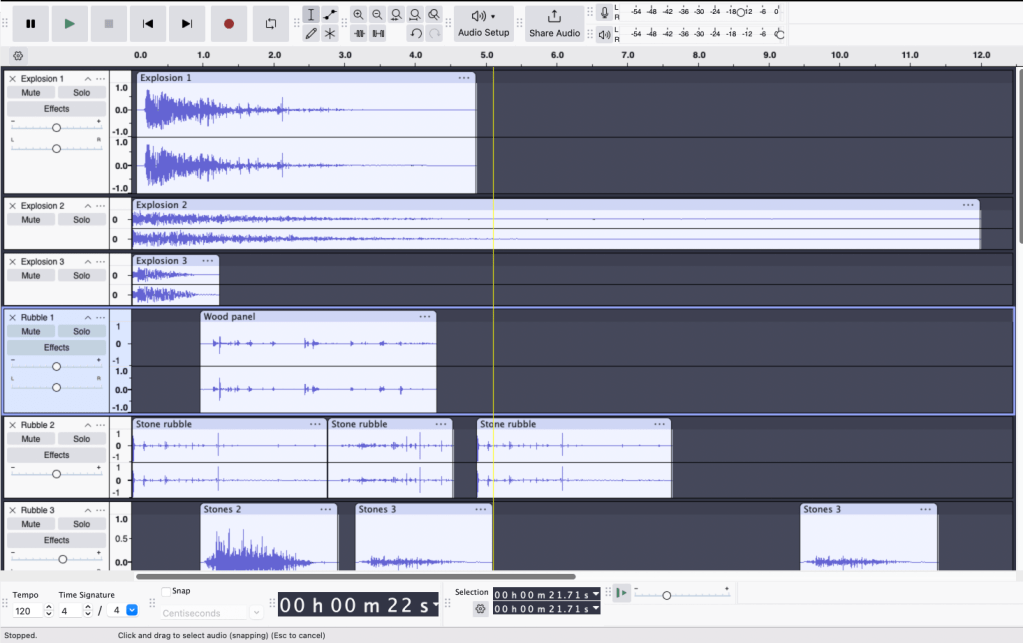
This cue is the windmill explosion as the humans sabotage the animals’ work. This was created from stock explosion and rumble recordings. The director particularly wanted a lot of rumble falling from the explosion. While accompanied with a light cue, the windmill was off stage at this point, so the audience just saw the plunger being pushed.

Some cues in the QLab are broken since the screen shot was taken on a computer without the licenses.
Animal Farm
Gettysburg College Theatre Department, Kline Theatre
Oct. 24-27, 2024
Director: Trazana Beverly
Scenic Design: Eric Berninghausen
Costume Design: Juls Buehrer
Lighting Design: Jonathan Stiles
Sound Design: Nicholas Ryan
Photos: Grace Jurchak
I served as the sound designer, head electrician, and projection technician for this production. The director had a strong vision of adapting the music and applying the story to the present. A live cello was used for underscoring for portions of the show. While we had discussed mic’ing the cello, but we determined it was sufficiently loud to not be mic’ed. We did mic the narrator since to help both the audience and cast hear them better. I did put up monitors above the stage for this as well as helping the cast hear the SFX. This was more of a safety measure, and I don’t think they were actually necessary due to the amount of reflection from the house speakers. Old Major was mic’ed for his opening monologue since his manner of delivery did not allow for sufficient projection to the audience. Napoleon was mic’ed for one monologue which was delivered over an ensemble song.
The projections were created by the scenic designer, and I did the cueing for the projections. The director liked the double image created from the scrim and the back wall. We were not able to significantly adjust the projector since it is managed by IT, but I did refocus it to better suit out needs. There was also some editing of the projection field I had to do as two mobile barn doors cut into the projection field for some scenes which required cutting off the bottom of the image to avoid it being caught by the doors.
 Nicholas Ryan